



Free Shipping Doesn’t Have to Kill Your Margins: A 2026 Strategy Guide
Time to read: 5 minutes There is a bit of a running joke in the e-commerce world: customers will happily pay $50 for a t-shirt, but they will abandon a cart in a heartbeat if they see a $5 shipping fee at checkout.
It sounds irrational, but the data backs it up. According to research statistics, 48% of shoppers abandon their carts specifically because of extra shipping costs. In fact, 66% of consumers now expect free shipping on every single order they place. For founders, this creates a difficult tension. You know that “Free Shipping” is your most powerful conversion lever, but you also know that shipping isn’t actually free—someone has to pay for the fuel, the box, and the labor.
If you don’t have a plan, free shipping quickly turns from a growth strategy into a “margin tax” that quietly drains your profitability. The goal isn’t just to offer the perk; it’s to offer it sustainably.
Here is how high-growth brands are providing free shipping in 2026 without sacrificing their bottom line.
1. Set Strategic Free Shipping Thresholds
The most common mistake brands make is setting a free shipping threshold based on a “gut feeling” (e.g., “let’s just do $50”). A better approach is to use your Average Order Value (AOV) as the anchor.
Standard industry data suggests that a free shipping threshold should be roughly 20-30% higher than your current AOV. If your average customer spends $45, setting your threshold at $60 encourages them to add “just one more item” to their cart. This doesn’t just cover the shipping cost; it actually increases your total revenue per customer.
Research shows that 80% of consumers are willing to spend more just to unlock free shipping. By treating your threshold as a tool for “basket building,” you turn a shipping expense into an upselling opportunity.

2. Localize Inventory to Slash Transit Costs
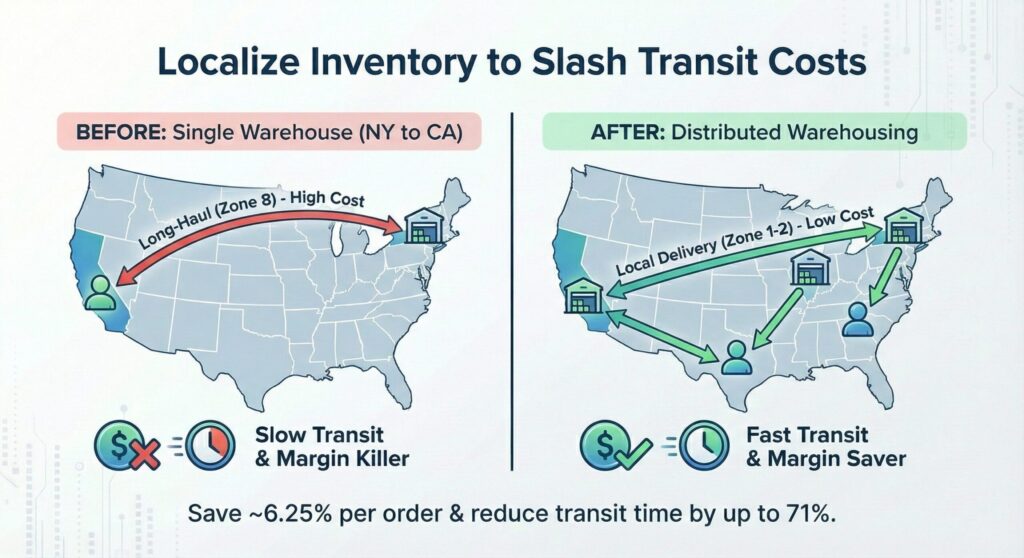
If you are shipping everything from a single warehouse in New York to a customer in California, you are paying for “Zone 8” shipping—the most expensive domestic rate. When your inventory is stuck on the other side of the country, the shipping cost alone can swallow your entire profit margin.
High-growth brands are solving this by adopting Distributed Warehousing. By spreading your stock across multiple fulfillment centers, you ensure that the product is already sitting close to the customer before they even hit “buy.” This effectively turns expensive long-haul shipments into affordable, local final-mile deliveries.
When deciding whether to implement this, consider your operational profile: distributed warehousing is most effective when your SKU count is manageable and your volume exceeds roughly 1,000 orders per month per region. This is particularly crucial if your products are heavy, as the cost of long-zone shipping will quickly outweigh the incremental cost of additional warehouse rent.
Brands using this model save an average of 6.25% per order while reducing transit times by up to 71%, making it much easier to absorb the shipping fee.
3. Minimize Tariffs with Direct Line Shipping
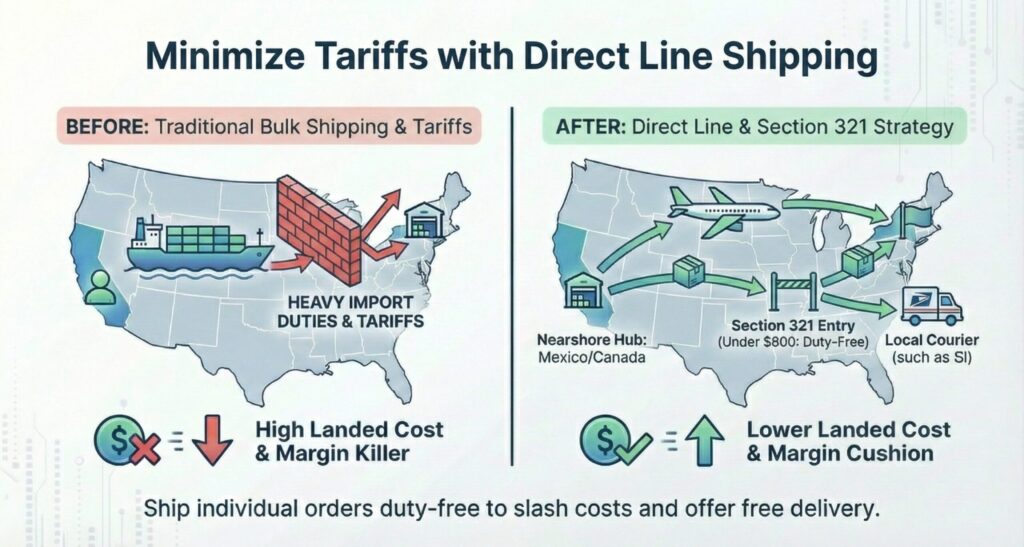
For brands managing global supply chains, the “landed cost”—the total price of getting a product from the factory floor to the customer’s porch—is the ultimate margin-killer. If you’re paying heavy import duties on top of high freight costs, your ability to offer free shipping vanishes before the customer even hits your site. This is where strategic shipping methods like “Direct Line” become a competitive necessity.
Direct Line shipping effectively kills the binary choice between “cheap but slow” international post and “fast but bankrupting” express air freight. By flying consolidated shipments into a destination country and “injecting” them directly into local courier networks like USPS or Royal Mail, you get the delivery speeds customers crave at a fraction of the cost of traditional express carriers. It is the middle ground that keeps your logistics lean and your customers happy.
The real financial leverage comes from pairing this with Section 321. Even with the customs updates we’ve seen leading into 2026, savvy brands are still utilizing Section 321 to ship individual orders valued at $800 or less into the US entirely duty-free. The trick is to fulfill from bonded warehouses in nearshore hubs like Canada or Mexico. This allows you to bypass the heavy, upfront tariffs typically associated with bulk ocean freight.
Instead of paying duties on a massive container, you ship individual orders across the border that qualify for the de minimis exemption. When you slash your landed cost this aggressively, you finally create the “margin cushion” required to offer free delivery to the end user without it feeling like a penalty on your profit.
4. Right-Size Packaging to Cut Shipping Waste
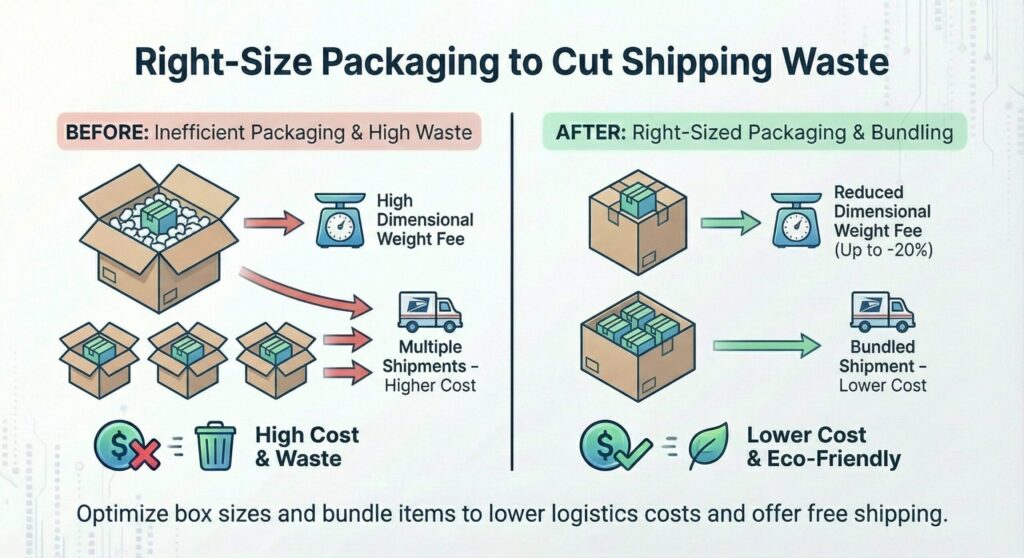
Weight and dimensions are the two biggest variables in your shipping bill. Sometimes, the difference between a profit and a loss is simply the size of the box you use.
- Right-sizing: Using automated packaging that fits the product perfectly can reduce “dimensional weight” fees by up to 20%.
- Bundling: Encourage customers to buy pre-set kits or bundles. Shipping one box containing three items is significantly cheaper than shipping three separate boxes.
By designing your product offers with “shipping efficiency” in mind, you can offer the free shipping perk while actually lowering your internal logistics costs.
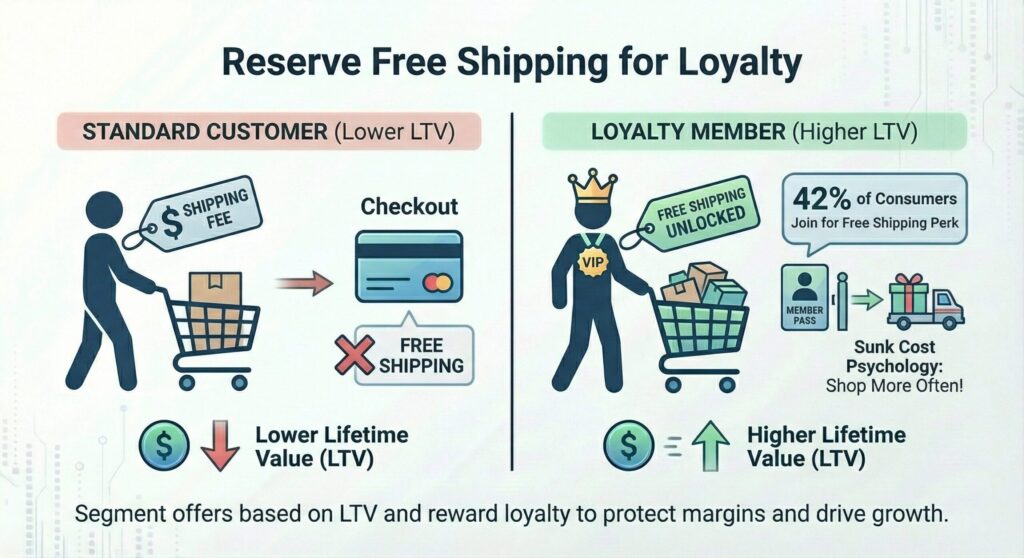
5. Reserve Free Shipping for Loyalty
You don’t have to offer free shipping to everyone, all the time. Many successful 2026 brands are using it as a reward for loyalty, with approximately 42% of consumers saying they would join a membership program specifically to unlock this perk. This allows you to segment your offer based on Lifetime Value (LTV).
Global brands like MandM (which offers unlimited Standard or Express Delivery depending on membership level) and ASOS have perfected this “sunk cost” psychology—once a customer pays for a delivery membership, they shop more frequently to maximize their value. Similarly, Sephora uses tiered loyalty rewards, where their most valuable VIPs get free shipping, protecting margins on one-off buys while doubling down on growth.
The Strategic Path Forward
Ultimately, the goal is to build a logistics engine that grows with you rather than holding you back. In 2026, free shipping isn’t just a “nice to have”—it is a fundamental requirement for staying competitive.
By aligning smart Direct Line shipping and Section 321 advantages with data-driven thresholds and loyalty tiers, you stop treating your supply chain as an unavoidable cost. Instead, you turn it into a high-performance profit engine that drives conversions while protecting your bottom line.
At Zhenhub, we’re all about taking the “black box” out of global fulfillment. We help you put inventory right where your customers are, slashing shipping zones and costs in the process. Ready to make your logistics sustainable? Explore how Zhenhub can help you scale. [Explore how Zhenhub can help you scale]